
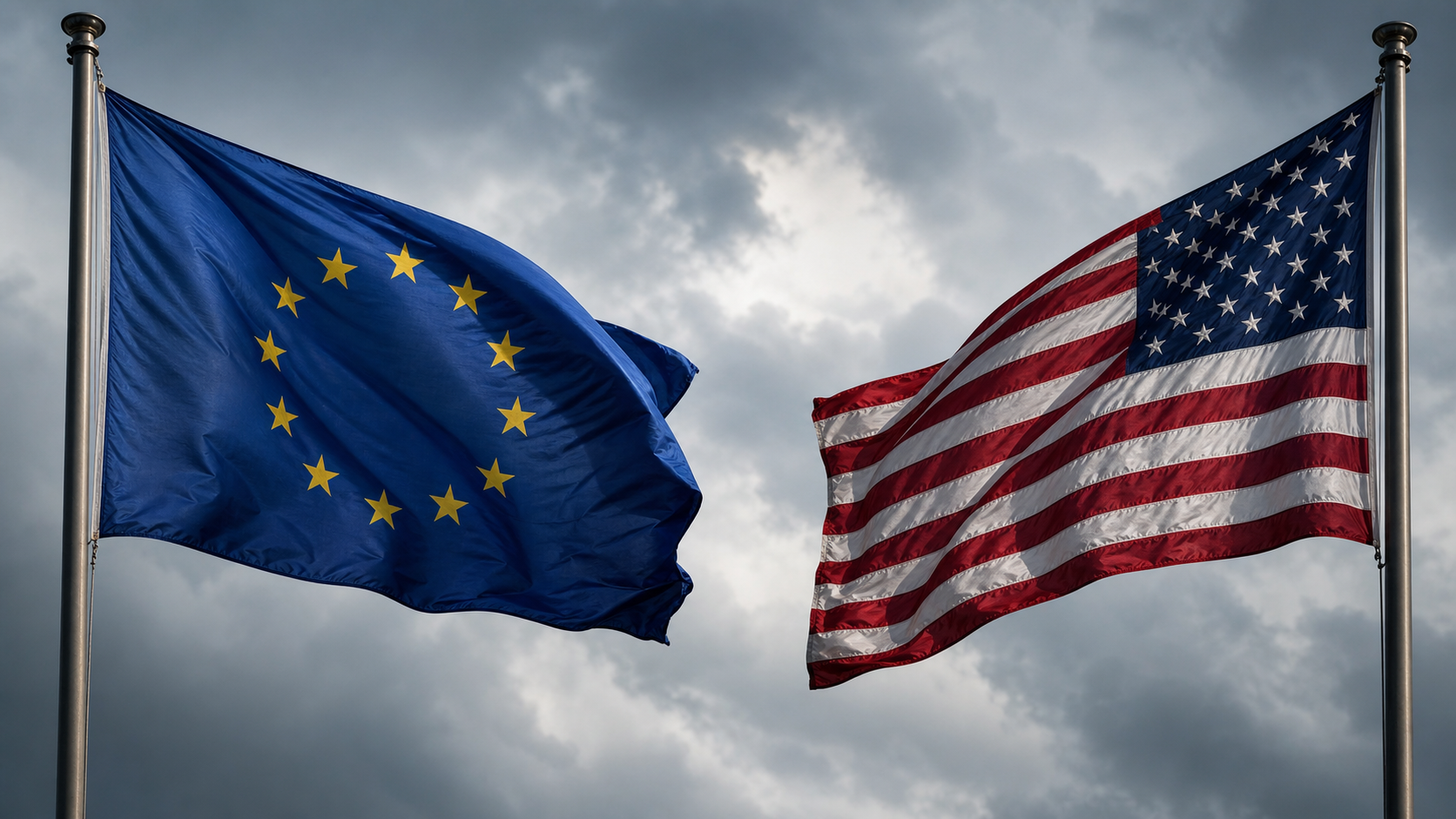
Since the DMA (Digital Markets Act) and DSA (Digital Services Act) have become applicable, we are seeing a digital and economic war between the EU and the USA. Tech giants accuse our continent of hindering technological innovation. At the same time, the EU tries to remain categorical in its application of these regulations.
The regulatory standoff: Big Tech pushback against EU rules
At the beginning of October, Apple and Google published press releases in which they criticized European regulation, especially the DMA and the DSA. In fact, they argue that because of them, different services are delayed in Europe. For instance, AI Overviews from Google are still unavailable in France. They have to ensure the technology’s compliance with the requirements of transparency. Another example is the new functionality of Apple AirPods. They are now able to translate a conversation live. Their arguments are that European consumers are deprived of their services. Apple is going further and asking to go beyond this regulation and adopt another, more appropriate one.
Europe’s regulatory arsenal: protecting customers or hindering innovation?
Since their entry into force in 2022, with effective dates in 2023 and 2024, we have seen that these texts are constitutive of a real problem. However, their goal is to protect consumers.
First and foremost, the DMA’s purpose is to avoid abuse of a dominant position by the gatekeepers. That means, for example, the prohibition of self-preferencing, ensuring interoperability, open access to data, etc. In other words, the text aims to prevent large American tech companies from crushing competition in favor of their own services, such as comparison sites or mapping, in the case of Google. Then, the DSA regulates Internet content and tries to avoid problematic content like online hate, misinformation, etc. To sum up, Europe has established real legal power thanks to its regulatory arsenal. It is probably the “most powerful in the world” according to the MEP Stéphanie Yon-Courtin.
The Trump factor: political power trumps legal authority
In spite of the EU’s legal power, the US maintains strong political power. In fact, GAFAM can count on a powerful ally: Donald Trump. Since his return to the White House, he has been a strong supporter of the gatekeepers (Meta, Apple, Amazon, etc.), much to their satisfaction. One notable example is Mark Zuckerberg, who chose to change the paradigm by reducing Facebook’s moderation. They are therefore now taking advantage of this to establish their dominance of the global economic and technological market. In reality, having a conservative president and a businessman such as Donald Trump is an advantage. Furthermore, his unpredictability contributes to a certain amount of confusion in the EU’s response and benefits GAFAM. Indeed, Trump does not hesitate to use blackmail as a weapon. He has even threatened trade and customs reprisals if Europe imposed fines on Big Tech. On August 26th, the European Commission responded to this attack by saying that the EU is sovereign in the enforcement of the law within its territory. Precisely, to establish its legal sovereignty, the EU has, since the beginning of the year 2025, imposed 500 million euros in fines against Apple, 200 million against Meta, and 3 billion against Google. But in reality, it is possible to say that the continent is making sure to adapt to the demands of the United States and not to upset President Trump too much. For instance, it minimizes the sanctions it imposes, deadlines are not respected, the qualification chosen is the least irritating for the US president, and it imposes small fines. To cite a recent example, on September 1st, 2025, the European Commission deferred a sanction for abuse of a dominant position against Google for fear that President Trump might raise his tariffs again. All of this shows that despite apparent sovereignty, the EU is conscious that it depends on American power and repeatedly uses its room for manoeuvre when it comes to cracking down on unfair American practices.
Structural dependencies: why Europe cannot escape American tech dominance
But how can we explain this dependence? First, the United States does not prioritize regulation and focuses entirely on progress, even if this leads to unfair competition, abuse of a dominant position, or a lack of user data security. There is therefore no legal barrier to innovation. Moreover, due to cultural differences, they are not afraid of failure, and starting a company is easier than in Europe. As a result, they have been able to build a true empire of technology. Connected to this historical element, the continent does not have an equivalent. Despite some attempts at applications more respectful of personal data, such as Qwant (a French search engine), or Signal (a competitor to WhatsApp, respectful of privacy), there is no real competitor to American Big Tech. In addition, most American tech companies hold personal data of European people through cloud services like Amazon Web Services (AWS) and use them to train their AI (artificial intelligence) models. Finally, we can also say that Europe, as a consequence of all this, is an important consumer of American technologies, especially of Apple’s and Google’s products.
Conclusion: a fragile sovereignty and the AI bubble wildcard
The standoff between the European Union and the United States over the DMA and DSA reveals a profound asymmetry in the global digital balance of power. On one side, Europe holds a powerful regulatory arsenal, designed to protect citizens against abuse of dominant positions and problematic content. On the other side, tech giants benefit from powerful support from the White House and significant technological advancement, the result of an entrepreneurial culture and an absence of regulatory texts.
This confrontation highlights a paradox: Europe, despite its legal sovereignty, stays trapped in its structural dependence on American technologies. The fines imposed against Apple, Meta, and Google, although symbolically significant, remain weak in light of Trump’s trade retaliation. The lack of credible European alternatives to GAFAM services turns regulation into a balancing act, with Brussels attempting to protect its citizens without triggering an economic escalation that it could not handle. Certain French companies, such as Mistral AI and OVHcloud, have understood this and are attempting to use the French legal arsenal as a selling point to conquer the market.
Beyond this legal conflict, another question arises: that of the economic viability of the current model. The massive investments in AI, supported by American giants, contribute to skyrocketing stock valuations. Some analysts are already warning of the risks of an AI-related speculative bubble. If this bubble were to burst, it could reshuffle the global digital power cards and offer Europe a window of opportunity to finally build its own technological sovereignty. But it would still need to be ready to seize it.
Sources :


