
Introduction
The digital economy has profoundly changed the way societies consume, exchange value, and produce. From artificial intelligence to online commerce, technological tools are now ubiquitous in working life and various business activities.Today, almost everyone uses the internet, especially in Europe, where online shopping continues to grow, demonstrating the scale and capacity of the digital world.
The digital economy is reshaping global competition and transforming the labor market and industries. To understand economic resilience, innovation, and the future of growth, it is important to grasp what the digital economy is and how it works.
What is the digital economy?
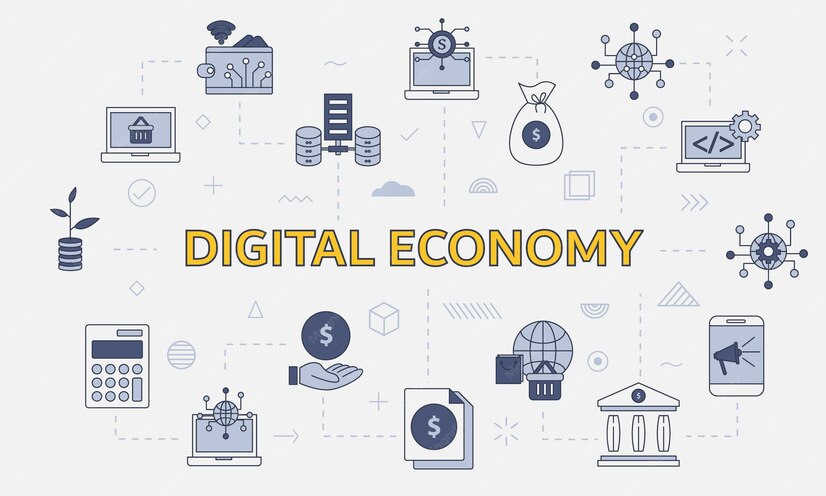
The digital economy can be defined as the set of economic activities enhanced by the development of digital technologies, such as cloud computing, artificial intelligence, the internet, and data exploitation.
In France, the digital economy has reached a significant level thanks to the continuous expansion of digital services and innovation. The fundamental elements of the digital economy are data, the cloud, and digital platforms.These points make it possible to create an environment in which businesses and consumers can interact continuously.
Digital infrastructure
Digital infrastructure includes digital data, cloud computing, and communication networks. Widespread internet access in Europe has enabled the rapid integration of digital services; approximately 90% of people in Europe use connected devices.In France, 5G networks and the deployment of fiber optics have strengthened these digital foundations.
It is important to have a highly reliable infrastructure because it guarantees the smooth, secure, and efficient flow of data. Technological tools such as the cloud, digital platforms, and artificial intelligence cannot function properly without reliable infrastructure.
Digital platforms and services
Digital platforms (cloud services, digital data, marketplaces, and online platforms) play a significant role in the digital economy. They facilitate the distribution of content worldwide, communication, and transactions.
E-commerce has experienced sustained growth in France, driven by evolving consumer behavior. These platforms allow businesses to expand beyond national borders by reducing barriers to entry without requiring a physical presence.
Data and artificial intelligence
Data is crucial in the digital economy. Through technological tools, businesses collect and analyze vast amounts of data to anticipate, predict, personalize services, analyze trends, and generate economic value.
Artificial intelligence optimizes these processes by automating decision-making and improving operational efficiency. The widespread adoption of digital tools in Europe demonstrates the rapid pace at which these technologies are becoming commonplace.
The digital economy in France
France is one of the major players in digital technology in Europe, thanks to ambitious public policies, dynamic innovation ecosystems and increasing adoption by businesses.
Growth and economic contribution
The expansion of digital technology in France is supported by investments in digital tools and services. Consequently, recent data indicates that digital tools and services have contributed significantly to economic growth, specifically through exports and business investment.
In 2025, the French economy grew by 0.9%, with digital services playing a significant role in exports and business investment. This demonstrates that digitalization is not just a sector, but a driver of overall economic performance.
Business digitization
The majority of French companies are engaged in digital transformation; they also have a digital strategy, often centered on technologies such as artificial intelligence.
Cloud integration is also widespread: nearly 90% of SMEs use cloud services that offer them greater flexibility and improved development. These changes are transforming traditional sectors, from manufacturing to retail.
Advantages of the digital economy
Digital technologies facilitate processes, reduce costs and improve productivity.
Automation and artificial intelligence allow businesses to perform tasks faster and with greater accuracy.
Conclusion
The digital economy has become essential to modern economic activity. Its influence extends to all sectors of activity, changing the way businesses operate.
Thanks to technological developments and its growing global success, the digital economy will remain an important driver of growth and innovation.
However, its success depends on the ability to address challenges such as inequality, cybersecurity, and regulation.
https://www.sciencedirect.com/science/article/pii/S2090447923003003
https://digital-skills-jobs.europa.eu/en/latest/news/how-europeans-use-internet-2025-insights-eurostat
https://www.worldbank.org/en/publication/dptr2025-ai-foundations
https://www.sciencedirect.com/science/article/pii/S2090447923003003
https://digital-strategy.ec.europa.eu/en/factpages/france-2025-digital-decade-country-report
https://commission.europa.eu/news-and-media/news/getting-eus-digital-infrastructures-ready-tomorrows-world-2024-02-21_en
https://commission.europa.eu/strategy-and-policy/priorities-2019-2024/europe-fit-digital-age_en
https://www.sciencedirect.com/science/article/abs/pii/S1471772725000089
https://unctad.org/publication/digital-economy-report-2024
https://www.trade.gov/country-commercial-guides/france-digital-economy
https://www.lemonde.fr/en/economy/article/2026/01/30/french-economy-grew-slightly-more-than-expected-in-2025_6749963_19.html
https://www.sciencedirect.com/science/article/pii/S2773207X24001386


