
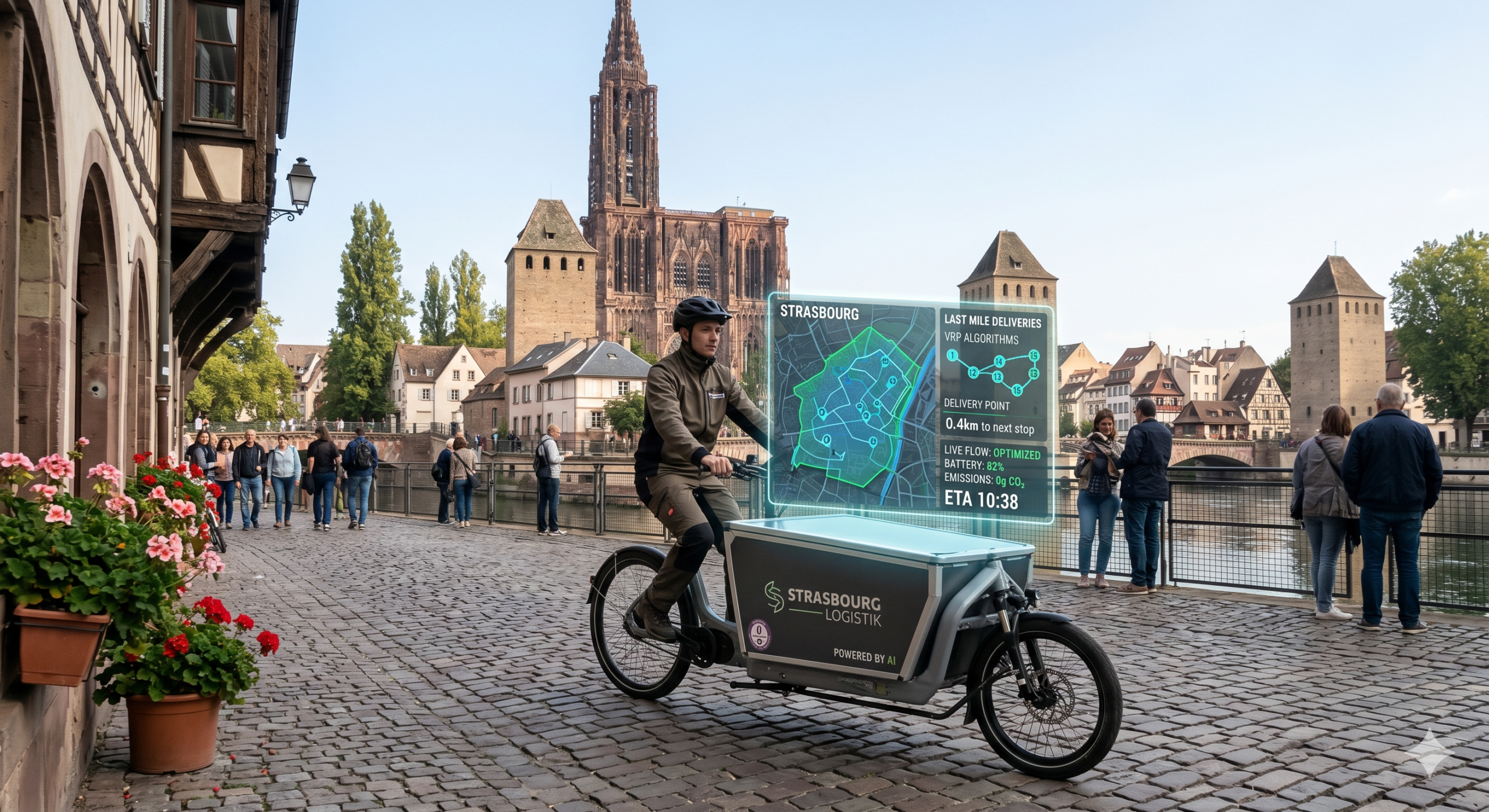
In the e-commerce sector, consumers now expect near-instant delivery almost without exception. Faced with this surge in logistics flows, most huges cities are taking a tougher stance to protect their environment. This regulatory shift is particularly evident in the establishment of Low-Emission Zones (LEZs), which are gradually restricting internal combustion engine vehicles’ access to city centers.
The last mile remains a principal challenge, accounting for 30% to 50% of total transportation costs. Faced with the imperative of decarbonization and shrinking margins, logistics players are turning to Artificial Intelligence. AI is emerging as the essential solution for maintaining distribution efficiency in increasingly regulated urban areas.
1. The Financial Burden of Urban Delivery
Delivering goods to a buyer’s doorstep is by far the most expensive segment of the supply chain. The figures reveal a glaring imbalance: the last mile represents between 35% and 53% of the total cost of a shipment. In fact, the situation borders on economic absurdity, on average, delivering a package costs a carrier $10.10, while they can only charge $8.08. This structural deficit forces carriers into a relentless hunt to eliminate every unnecessary kilometer.
Today’s cities are rife with costly obstacles. Between traffic congestion and a shortage of parking spaces, efficiency often plummets. In most of the metropolitan areas, logistics occupy 30% of public space and generate 20% of total traffic. A delivery vehicle stuck in traffic burns fuel for nothing, instantly erasing the profitability of its route. Added to this is the problem of failed deliveries; so a missed recipient costs exactly $17.78 per incident, a single failure is often enough to wipe out the profits from several successful deliveries.
Regulatory constraints complete this challenging picture. With the rise of LEZs, older diesel vans are being banned. To keep operating, companies must replace their fleets at breakneck speed. For example, replacing a €30,000 diesel van with its electric equivalent requires an investment of nearly €45,000. Simply increasing fleet size to deliver more packages would lead straight to financial disaster. To preserve margins, a strategic shift is needed: leveraging the power of algorithms to optimize every meter traveled.
2. Dynamic Routing as a Power Algorithm
The days of planning delivery routes with a pen and a whiteboard are long gone. Faced with the complexity of e-commerce, AI is taking over through high-performance Transportation Management Systems (TMS). To solve the routing puzzle, the famous Vehicle Routing Problem (VRP), algorithms process dozens of variables in real time: time slots, load capacity, battery range, and live traffic data. The goal is to map out the most cost-effective and least polluting route possible.
The strength of this technology lies in its ability to adapt to local constraints. As a vehicle approaches an LEZ, the AI automatically assigns the right asset to the right area: cargo bikes or small electric vans for the city center, and heavier trucks for the outskirts. The system recalculates everything on the fly to bypass sudden traffic jams, ensuring maximum flow without increasing driver stress. In the field, the results speak for themselves. Algorithmic optimization can reduce operational costs by 25% and improve route efficiency by 30%. Concrete feedback shows that integrating these smart tools already saves 1.5 liters of fuel per 100 kilometers.
The real benefit also lies in eliminating deadhead or empty-run miles. Take the case of Transarc, by deploying an optimization algorithm, the company eliminated hundreds of thousands of unnecessary miles in just six months. The investment paid for itself in a single quarter. By avoiding detours, AI hits where it hurts and gives carriers a definitive competitive edge.
3. The Synergy Between Data and Urban Micro-Hubs
We must, however, be realistic, computing power eventually reaches its physical limits. Optimizing a route digitally is pointless if the delivery person has to park several blocks away from the destination. Data must be translated into the physical world through local micro-hubs and a reorganization of the urban landscape. The solution lies in Urban Logistics Spaces (ULS). These small warehouses, ranging from 100 to 1,000 square meters, are appearing in underground parking garages, brownfields, or vacant spaces. The principle is simple, heavy-duty trucks unload their cargo before dawn, before traffic congestion sets in. AI then coordinates the distribution of these goods to lightweight, carbon-neutral fleets.
Cargo bikes and small, clean utility vehicles take over from there. Being agile, they weave through pedestrian zones and LEZs with ease. We are even seeing river-based solutions emerge, for exemple in Paris, the operator Fludis uses an electric barge as a floating warehouse. Orders are prepared on board while the boat is in transit to supply bike couriers directly at the docks, a precise choreography that replaces the chaos of diesel vans.
Finally, predictive analytics tackles the problem of failed deliveries. By refining delivery time estimates using machine learning, the system narrows the time window provided to the customer. A simple automated text alerts the customer to the imminent arrival, the package is delivered on the first attempt, and the route’s profitability is secured.
Preserving profit margins in the age of Low-Emission Zones is no longer just about changing engines. Artificial Intelligence, coupled with neighborhood micro-hubs, transforms an environmental constraint into a competitive advantage. The players who master this shift will secure their business model for the coming decade. The next challenge will likely be political rather than technical, ensuring full data interoperability between municipalities, retailers, and carriers. Breaking down these software silos is the final frontier in optimizing urban space.
Additional sources :
https://logistique-magazine.fr/2026/04/09/logistique-dernier-kilometre/
https://makeamove.fr/zfe-entreprises-2026/
https://www.sigma.fr/publications/blog/supply-chain/reduire-empreinte-carbone-transports/

D’origine péruvienne, je suis titulaire d’une Licence de Droit obtenue au Pérou, ainsi que d’une Licence Administration Économique et Sociale (AES) en France. Actuellement, j’effectue mon M2 AES, spécialité Commerce Électronique, à l’Université de Strasbourg pour l’année universitaire 2025-2026

