
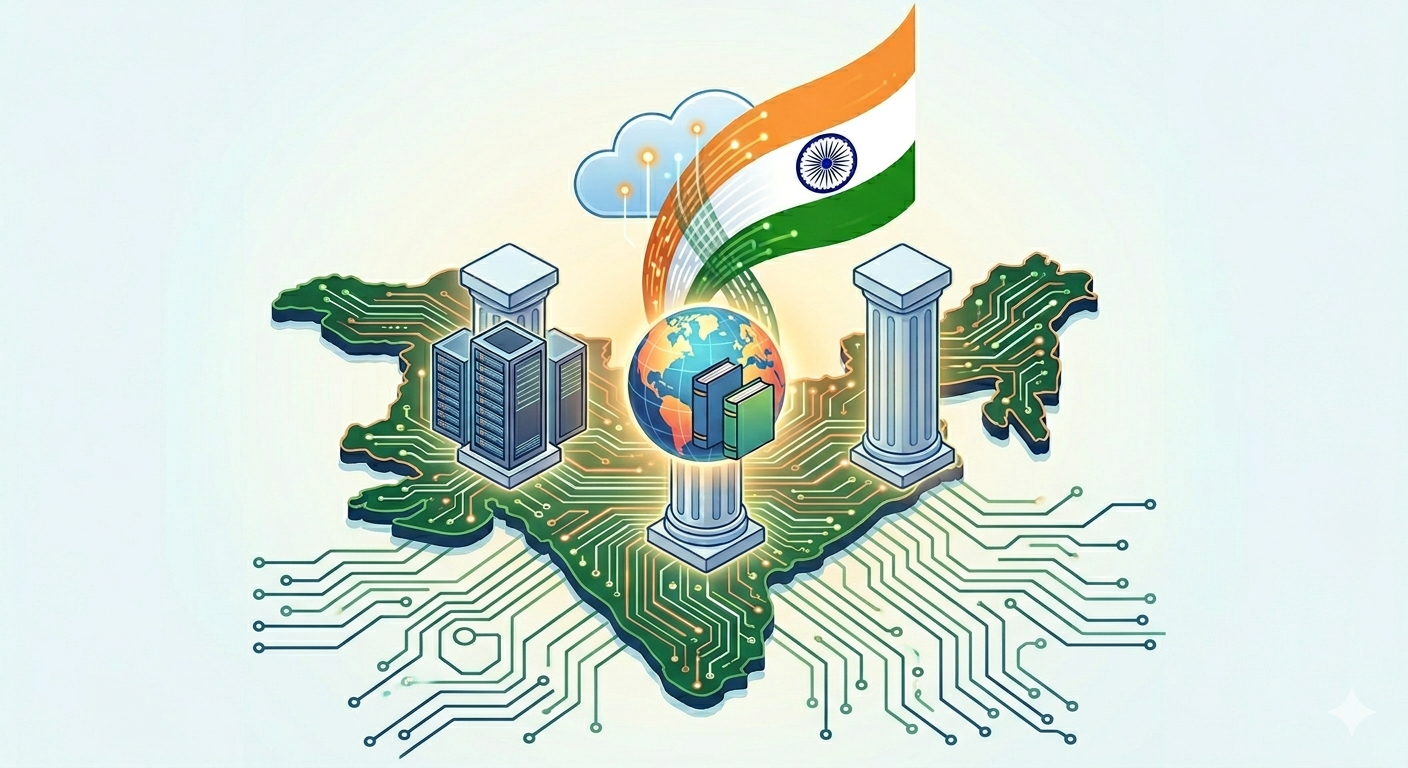
In 2026, India’s AI strategy has moved to concrete institutional action. The country is committing real funding and institutional structures to back its ambitions. The core objective is to build an Indian-governed AI ecosystem, rather than remaining dependent on American or Chinese technology platforms. To achieve this, the government is investing across three main areas: computing infrastructure, locally relevant datasets and governance frameworks.
The India AI Impact Summit 2026
In early 2026, India organized a major international AI summit under the banner of « from vision to action ». The signal is clear, India no longer sees itself as a passive consumer of AI technology, it intends to help shape the global rules. The summit brought together cloud providers, investors and research institutions from across the world. The dual objective was notable. On one hand, India was actively seeking global partnerships and foreign investment. On the other hand, it was advancing its own normative vision, in which AI development is accessible, inclusive and subject to meaningful accountability. This represents a significant shift in posture. India is positioning itself as a standard-setter, not simply a standard-follower.
Policy in practice: The IndiaAI Innovation Challenge
One of the most tangible policy steps of 2026 is the IndiaAI Innovation Challenge, launched in January of the same year. The mechanism is straightforward. The government runs a competitive process through which startup and research teams can submit AI project proposals. The strongest submissions receive funding, support for deployments and access to potential long-term public contracts. The priority sectors are practical: healthcare, legal dispute resolution, economic planning and public administration, among others. This approach is strategically significant because it positions the government as an active participant. By becoming an early customer for AI solutions, the state reduces financial risk for innovators while ensuring that funded projects serve a genuine public interest.
Three Pillars of the Strategy
India’s AI Strategy rests on three interconnected pillars. The first is access to computing power, since training large AI models requires expensive, specialized hardware. India is subsidizing access to this infrastructure so that small startups and academic researchers are not immediately priced out of the market. The second pillar is data in Indian languages and local contexts. Indeed, most leading AI models have been trained predominantly on English-language text, which significantly limits their usefulness for the majority of Indian users. India is therefore building datasets in dozens of regional languages, covering key sectors such as agriculture, healthcare and public administration. The third pillar is governance and oversight. Rather than allowing AI to develop without clear guardrails, India is conditioning its institutional support on compliance with requirements around security, privacy and transparency.
Several Core Tensions
Despite the coherence of this strategy, several tensions deserve careful attention. The first concerns sovereignty versus supply-chain dependency. India aspires to technological self-sufficiency in AI, yet it remains heavily reliant on internationally sourced chips and hardware. Full independence is a long-term prospect. The second tension relates to fairness in resource allocation. Subsidized computing infrastructure and selected datasets are valuable instruments for democratizing AI access, but they risk generating unfair advantages if government allocation processes favour certain partners without sufficient transparency. The third tension involves state influence over AI development. When a government determines which datasets are used and which models receive institutional backing, it accumulates significant influence over the direction of AI research. This raises legitimate questions about academic freedom and the concentration of decision-making power over what constitutes responsible AI.
Key Imperatives for a Sovereign AI Ecosystem
For this strategy to achieve its stated goals, several conditions must be met. Transparency in the allocation of subsidized computing resources is essential. Indeed, opaque or politically motivated decisions would quickly fragiliize public and institutional trust. Datasets governance processes must be open and subject to independent audit, so that researchers and citizens can examine how data is collected, selected and used. AI models developed with public funding should be released in ways that allow independent verification. Beyond large national projects, smaller institutions, regional developers and local communities need support too, because without them, the ecosystem risks remaining exclusive rather than inclusive. On the international front, India will still depend on global technology partners in the near term, making negotiation of fair and transparent agreements an ongoing priority.
Ultimately, India’s approach in 2026 combines economic strategy, public investment and a clear political vision: AI should be accessible, accountable and oriented toward the public good. Other countries, particularly across the Global South, are watching this experiment closely.
Sources :
- https://indiaai.gov.in/article/india-s-tryst-with-ai-advancing-technology-sovereignty-and-ai-democratization
- https://indiaai.gov.in/article/indiaai-innovation-challenge-2026
- https://impact.indiaai.gov.in/about-summit
- https://www.silicon.fr/business-1367/sommet-de-lia-2026-comment-linde-veut-tracer-sa-voie-225743
- https://www.kiteworks.com/fr/gestion-des-risques-lies-a-la-cybersecurite/india-ai-gouvernance-sommet-2026/

