
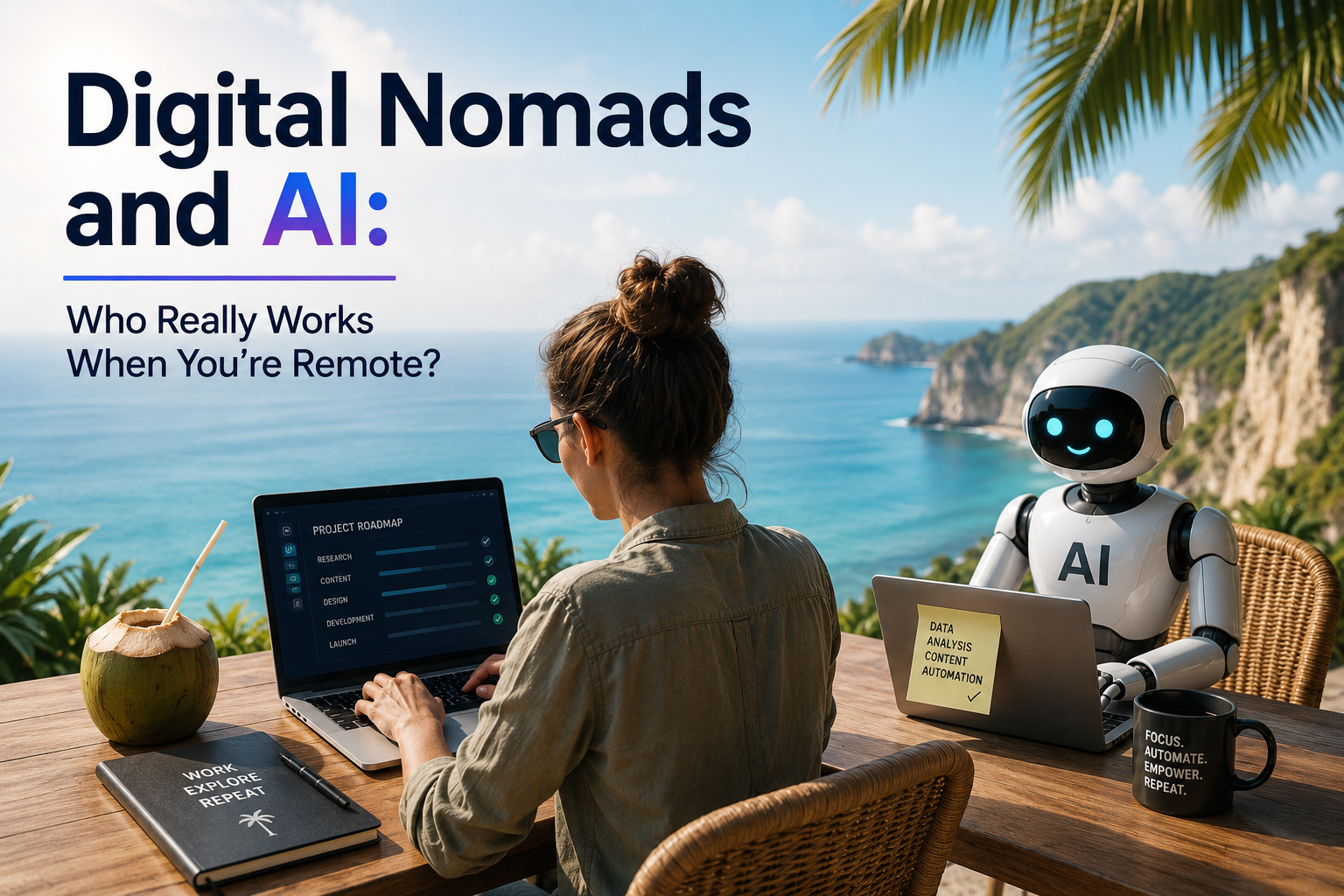
Remote work isn’t just a passing phase anymore it’s stuck around and transformed the way millions of people approach their jobs. Over the last ten years, and especially since the world shut down during COVID-19, office walls have blurred. You don’t need to sit under fluorescent lights to get things done. Now, a graphic designer might be editing logos from a Bali beach bar. A digital marketer’s juggling campaigns from a Paris café. And a software developer could be squashing bugs while zigzagging through South America. This way of working birthed a new tribe: digital nomads.
Digital nomads aren’t just a trend; they’re at the center of a growing professional culture. Mobility, flexibility, and technology are their lifeblood. If you scroll through social media, you’ll see sun-kissed laptops on sandy tables, but the reality behind that vibe is much messier.
While all this was brewing, artificial intelligence came swooping into professional life with astonishing speed. AI can churn out articles, debug code, analyze piles of data, translate real-time conversations, stitch together videos, and manage schedules—all in the time it takes to sip your coffee. Remote workers jumped on these tools right away. After all, their work already lives and breathes online.
Spend a week with any digital nomad and you’ll see: AI’s become the sidekick they never knew they needed. A freelance writer taps AI for headline ideas. Social media managers whip up dozens of ad versions in minutes. Web developers lean on AI to flag and fix coding errors. Routine stuff vanishes. Tasks shrink. Time frees up.
What does that mean? Well, workers spend less time tinkering and more time creating, building relationships, and focusing on bigger-picture strategies. For freelancers juggling several clients, every minute counts—this edge is gold.
But there’s another side to the story one not shown on Instagram. As AI integrates deeper, the bar keeps moving. Employers expect things faster. Deadlines slip closer. The pressure mounts. Many remote workers, especially freelancers and digital nomads, feel squeezed to prove their worth. You’re on a short-term contract, you live by your client’s mood, and now you’re racing against competitors armed with the same AI tools. The competition’s fierce, and the fear is real: what if your specialized skill loses value?
Work-life balance? It gets tricky. The digital nomad dream promises freedom, but plenty of folks find themselves glued to screens more than ever. The ability to work from anywhere sometimes means working everywhere. Pings, emails, and meetings follow you across time zones.
AI’s speed cranks up these expectations. If a tool dashes off a project in ten minutes, shouldn’t you be doing the same? Waiting feels old-fashioned. The pace gets relentless. Stress, exhaustion, and burnout shadow the digital nomad lifestyle.
And there’s the question of trust. In an office, managers see people at their desks. Remotely, that’s gone, so companies turn to surveillance tools software that tracks keystrokes, screenshots, and active hours. Layer on AI, and now algorithms are evaluating your output in real time. Many remote workers feel less trusted, more scrutinized.
This triggers ethical and legal debates, especially in Europe, about AI’s place at work and digital privacy. Businesses can’t ignore data protection and employee rights, and lawmakers have started to pay attention. There’s another layer: cybersecurity. Digital nomads log in from airports, hotels, busy coffee shops—hardly secure. Meanwhile, AI tools crunch through sensitive data. Stronger security rules are essential to keep that information out of the wrong hands.
Still, despite all the noise, AI isn’t about to push digital nomads out. Humans bring something to the table that machines can’t replace: creativity, emotional intelligence, adaptability, empathy, negotiation, cultural awareness the messy, complicated stuff at the heart of work. Sure, a content writer can get prompts from AI, but it takes a person to nail tone, humor, and what actually clicks with an audience. Consultants automate analysis, but clients still want real, human advice.
The rise of digital nomadism isn’t just about new technology. It’s a shift in what people want out of work—flexibility, freedom, and a life outside the cubicle. Young workers chase experiences, not just promotions or years in the same place. With remote work, you get to travel, learn, and grow global networks and AI smooths the way. Collaboration gets easier, translation tools break language barriers, AI assistants summarize meetings, project managers keep teams moving across time zones.
Still, the new world of work has its divides. Some savor the freedom, others face instability and isolation. Not everyone stepping into this future lands on solid ground. The real task isn’t just about better tech—it’s about building fair social and legal rules. The future won’t be a standoff between people and AI it’ll be a partnership. The companies that balance efficiency, ethics, employee well-being, and innovation will thrive. Digital nomads and AI are symbols of work’s ongoing evolution. And through it all, one thing is certain: technology speeds things up, but it’s human creativity, judgment, and emotional smarts that carve out real value.
Sources:
- https://www.weforum.org
- https://www.oecd.org
- https://www.europarl.europa.eu
- https://www.ibm.com
- https://www.mckinsey.com
- https://www.statista.com
- https://www.forbes.com
- https://www.bbc.com
