
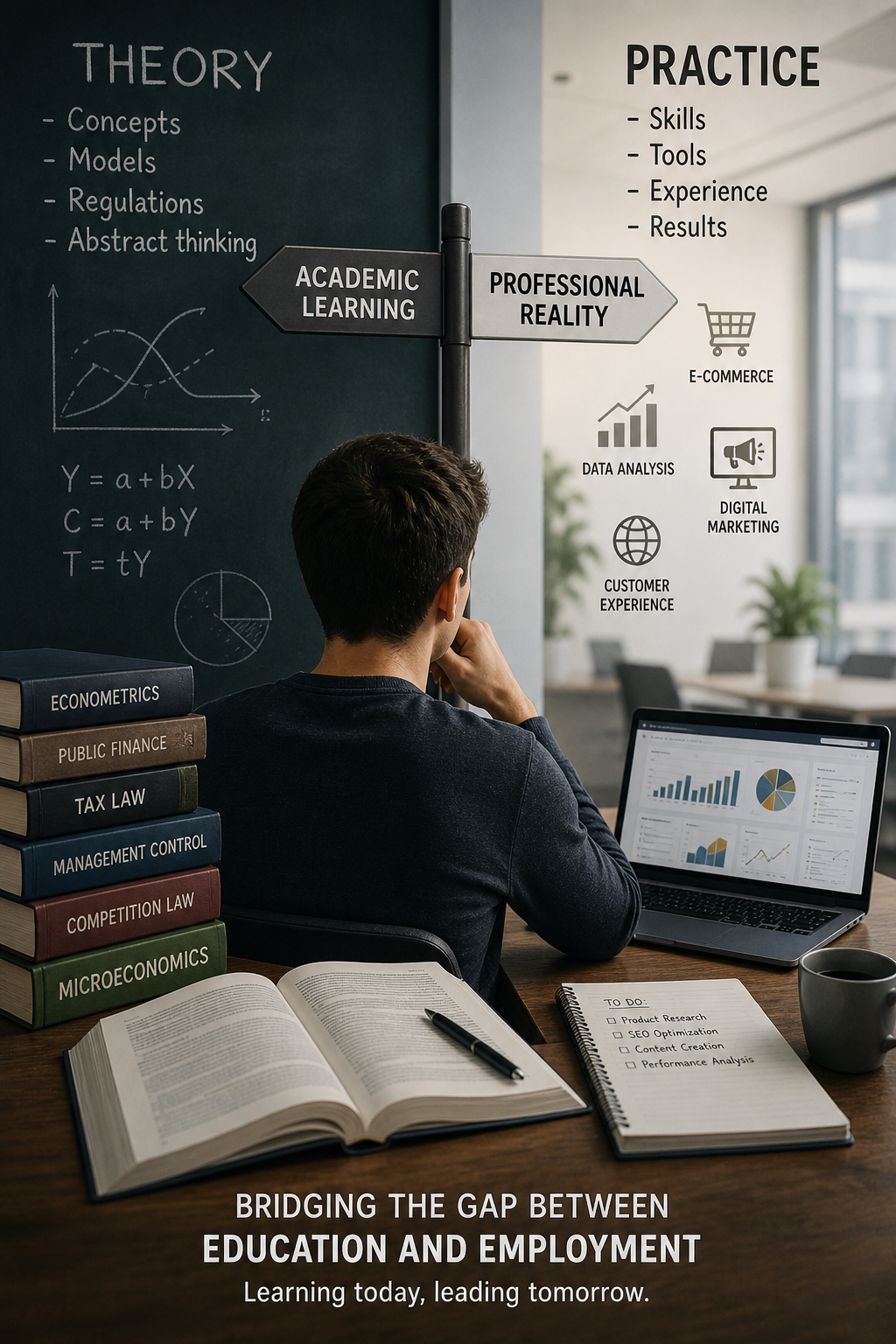
The transition from school to the professional world often marks a turning point for many students. After several years of study, they realize that the knowledge they have acquired is not always directly applicable in their professional activities. This observation raises an important question: is the education system fully aligned with the realities of the workplace?
During their studies, students are exposed to a wide range of subjects, some of which may seem far removed from their chosen field. This diversity can create the impression that certain courses are not particularly useful in a professional context. In the workplace, tasks are often practical, efficiency-driven, and require specific operational skills.
However, it would be an oversimplification to consider these subjects as useless. Education is not only about preparing students for a specific job; it also aims to provide a broad intellectual foundation, develop critical thinking, and structure reasoning. Many academic disciplines contribute to building essential transferable skills such as analytical thinking, rigor, and adaptability.
That said, an important issue deserves attention: some complementary courses play a significant role in academic evaluation. Students often invest considerable effort in mastering them in order to pass exams, sometimes relying on short-term memorization strategies. Yet, without practical application, much of this knowledge tends to be quickly forgotten after assessments. This can lead to the perception that such learning lacks relevance or long-term value.
This observation does not question the intrinsic value of these subjects, but rather their place and application within academic programs. The core issue lies in the gap between theoretical teaching and its practical use. When students fail to see the relevance of what they are learning, their motivation and engagement may decline.
In this context, rethinking teaching approaches becomes necessary. Without reducing the richness of academic content, it would be beneficial to place greater emphasis on essential subjects and strengthen their connection to real-world situations. Incorporating practical projects, case studies, and professional tools could help make learning more meaningful.
Furthermore, work-study programs (alternance) offer a relevant solution. By combining academic learning with real-world professional experience, they allow students to better understand the usefulness of their knowledge while developing directly applicable skills. This approach helps bridge the gap between education and employment.
The goal, therefore, is not to oppose theory and practice, but to strike a balance between the two. An effective education system should both provide solid knowledge and prepare students for their professional future.
In conclusion, while some knowledge may seem disconnected from professional realities or easily forgotten, it still contributes to building a fundamental foundation. The challenge for today’s education system is to better align content, emphasize truly useful learning, and promote long-term knowledge retention in line with the evolving demands of the professional world.
- https://www.cairn.info/revue-education-et-societes-2018-1-page-87.htm
- https://www.vie-publique.fr/eclairage/270426-alternance-definition-et-enjeux
- https://www.education.gouv.fr/le-role-de-l-ecole-4151
- https://www.letudiant.fr/jobsstages/alternance/alternance-un-atout-pour-l-emploi.html
- https://www.oecd.org/education/education-at-a-glance/


