
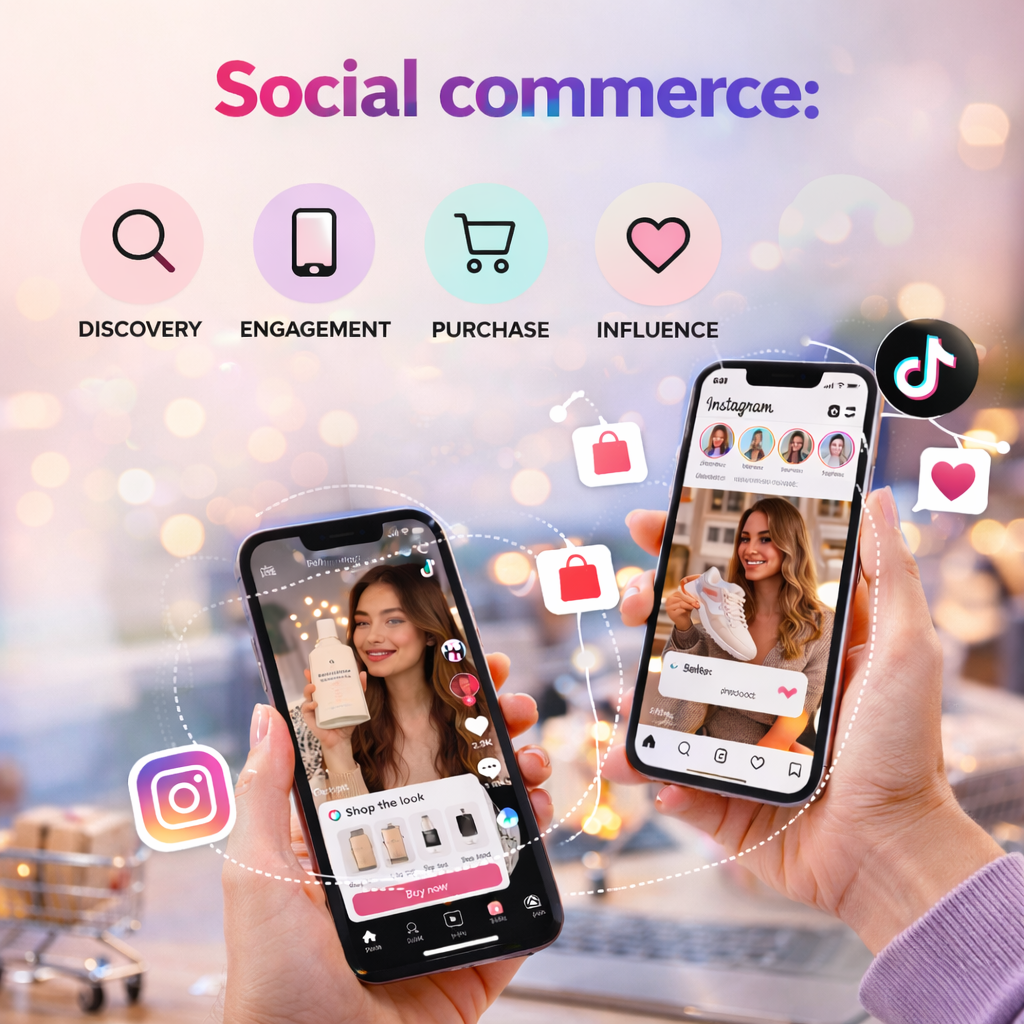
How TikTok and Instagram are reshaping online purchasing behaviours ?
Online shopping used to begin with a search bar. Today, it increasingly begins with a scroll. On TikTok and Instagram, the route from desire to purchase is no longer linear: people discover a product in a video, watch someone test it, read the comments, compare reactions, and sometimes buy it before they have even opened a browser tab. That shift is no longer marginal. EMARKETER estimates US social commerce sales reached $87.02 billion in 2025, up 21.5% year over year, and expects the market to top $100 billion in 2026.
TikTok has been the most radical force in that change because it does not behave like a traditional shop window. It behaves like entertainment first, retail second. A cleanser, blender or vitamin gummy does not appear as a product listing; it appears as a story, a hack, a confession, a before-and-after. The product is embedded in the spectacle. TikTok says brands and creators hosted more than 8 million hours of LIVE shopping sessions in the US in 2024, and reports that 76% of consumers who engaged with TikTok Shop bought something from a livestream in the previous year. That matters because it shows how commerce is being woven into attention itself. The old distinction between “content” and “checkout” is collapsing.
Instagram, by contrast, is reshaping purchasing behaviour in a quieter, more polished way. It is less bazaar, more showroom. For years, Instagram has trained users to consume taste: interiors, skincare routines, outfits, cafés, holiday aesthetics. Shopping was always implicit in that visual culture; now the platform keeps making it more explicit. In April 2026, EMARKETER reported that Instagram had again opened the door to affiliate commerce, allowing creators to tag products in Reels and earn commissions on resulting sales. The logic is clear: not every user wants the velocity of TikTok, but many are perfectly comfortable buying inside a lifestyle environment that feels curated, familiar and socially endorsed.
What both platforms have changed is the purchasing funnel itself. Discovery, persuasion and transaction increasingly happen in the same place, sometimes in the same minute. Deloitte Digital found in 2025 that 61% of consumers had discovered a new brand or product on social media in the previous 12 months. It also found that 71% described their most recent social-platform purchase as good or excellent, while 34% said an even easier payment process would make them more likely to buy. In other words, consumers are not merely tolerating shopping on social apps; many now expect it to be smooth, native and almost invisible.
This is also changing who persuades us. In classic e-commerce, trust was built through brand reputation, search ranking and formal reviews. In social commerce, trust is often borrowed from creators and communities. A recommendation now arrives with a face, a voice and a tone of intimacy. Pew Research found that 54% of social media users aged 18 to 29 say influencers affect what they buy at least a little; among women in that age group, the figure rises to 62%. Deloitte’s 2025 research adds another layer: 46% of consumers say customer reviews make them more likely to purchase on a social platform. The social proof is not only above the post anymore; it sits underneath it, in comments, remixes, reactions and testimonials.
The behavioural consequences are significant. Social platforms do not just make shopping easier; they make it more ambient and more impulsive. DHL’s 2025 social commerce report found that 37% of shoppers say social media makes them shop more frequently, while 31% say it leads them to make more impulse purchases. The same report found that 62% say customer reviews on social media influence their buying decisions and 58% want free delivery and returns on purchases made through social channels. That combination is powerful: emotional stimulus, social validation and minimal friction. Retail used to rely on planned intent. Social commerce thrives on suggestibility.
Still, TikTok and Instagram are not identical retail machines. TikTok is strongest when it creates sudden demand. Its algorithm is built for serendipity, velocity and viral conversion; a product can move from obscurity to sell-out status in hours. EMARKETER said TikTok Shop would account for nearly 20% of US social commerce in 2025. Instagram’s influence is often slower and more identity-driven. It works especially well where aspiration, self-presentation and repeat exposure matter: beauty, fashion, wellness, décor. DHL’s data also suggests a generational split, with Gen Z more likely than older shoppers to buy via Instagram and TikTok, while older users still lean more heavily toward Facebook. The result is not one model of social shopping, but two: TikTok as the engine of discovery-led impulse, Instagram as the architecture of taste-led conversion.
There is, however, a cost to this convenience. When shopping moves into feeds, platforms gain extraordinary power over visibility, persuasion and timing. Smaller brands can break through without buying a supermarket shelf, but they also become dependent on opaque algorithms, creator deals and trend cycles they do not control. Consumers gain speed, but not always clarity. The OECD has warned that online trading platforms can be abused by counterfeiters and illicit trade networks, a reminder that governance still struggles to keep pace with platform commerce. Social shopping feels informal, almost friendly, but the commercial infrastructure behind it is vast, automated and not always transparent.
That is why the real transformation is cultural as much as technological. TikTok and Instagram are not simply adding a “buy” button to social media. They are teaching people to treat shopping as a form of participation: to browse through personalities, validate choices through community, and make purchases inside the flow of everyday attention. For brands, the lesson is obvious: visibility now depends less on polished advertising than on native, credible presence. For consumers, the lesson is less comfortable. The easier shopping becomes, the more valuable hesitation becomes too. In the age of social commerce, the smartest click may no longer be the fastest one.
References :
Deloitte Digital. 2025 State of Social Research: How efficiency can meet impact with the right investments. 15 mai 2025.
Deloitte Digital – State of Social Research 2025
DHL eCommerce. 2025 Social Commerce Trends. 2025.
DHL – 2025 Social Commerce Trends
EMARKETER. Instagram launches affiliate program as its shopping influence slips. 2026.
EMARKETER – Instagram launches affiliate program
EMARKETER. TikTok Shop Makes Up Nearly 20% of Social Commerce in 2025. 9 décembre 2025.
EMARKETER – TikTok Shop Makes Up Nearly 20% of Social Commerce in 2025
OCDE. E-Commerce Challenges in Illicit Trade in Fakes. 2021.
OCDE – E-Commerce Challenges in Illicit Trade in Fakes
Pew Research Center — Michelle Faverio, Monica Anderson. For shopping, Americans turn to mobile phones while influencers become a factor. 21 novembre 2022.
Pew Research Center – Shopping, mobile phones and influencers
TikTok Newsroom. TikTok Shop is where shoppers come to discover. 13 juin 2025.
TikTok Newsroom – TikTok Shop is where shoppers come to discover

Étudiant en Master 2 Commerce Électronique et titulaire d’une licence en Économie.
Passionné par l’économie numérique, le e‑commerce et les stratégies d’innovation digitale, avec un intérêt particulier pour l’analyse des tendances et des transformations du marché.

