
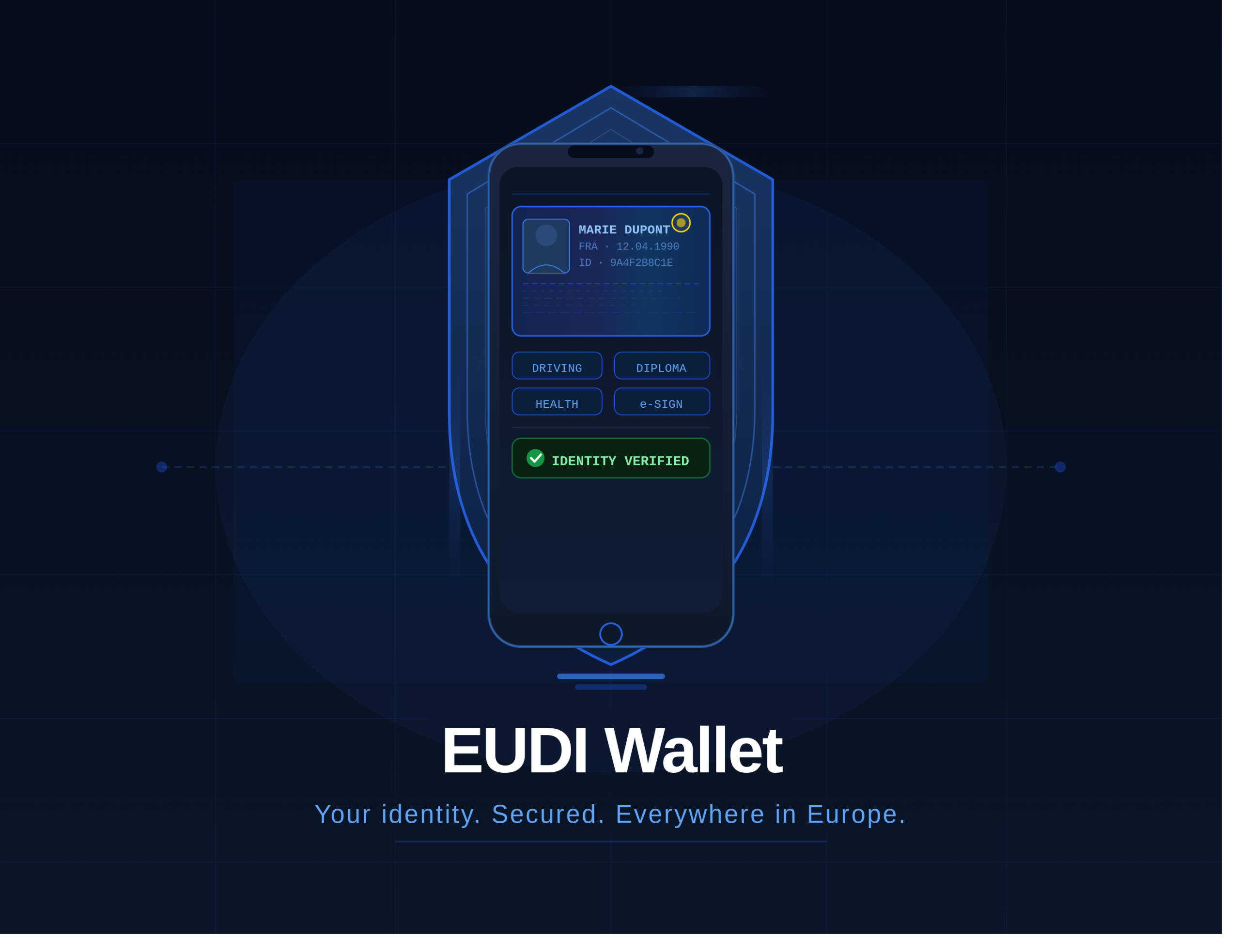
The European eIDAS 2.0 Regulation, adopted on April 11, 2024 (Regulation EU 2024/1183), aims to establish a reliable, secure and interoperable framework for electronic identification for European citizens and residents within the European Union (EU). Its goal is to facilitate and secure electronic transactions across the EU’s internal market. What if you could open a bank account, sign a contract or prove your diploma from your phone, without scanning a single document ? This EU regulation introduces the European Digital Identity Wallet (EUDI Wallet). It’s a government-backed mobile application that stores and shares your verified credentials securely across Europe. The EUDI Wallet will be legally recognized throughout the EU by 2026 and 2027, but what will it change in practice ?
EUDI Wallet explains
eIDAS 2.0 core ambition is to provide every European citizen with a free reliable digital identity across the entire EU.
EUDI Wallet is a secure digital application that allows users to store, manage and share identity credentials (national ID, passport) or official document (driver’s licence, university diploma, IBAN, vaccination certificate) with third parties. They are cryptographically certified, tamper-proof attestations validated by trusted authorities. It can also be used to log into online services.
In practice, it will be possible to opening a bank account in seconds, without submitting the document repeatedly. It also protects compagnies from PDF-based documentary fraud. Also, it would be possible to prove income instead of sharing a payslip. For example, EUDI Wallet can send a cryptographic proof confirming that a salary falls within a given range, without revealing the exact figure. So, users will be able to share only the data strictly necessary for a given procedure, ensuring compliance with the GDPR’s data-minimization principle.
A shield for the future of the digital economy
Today, documentary fraud is exploding. AI has made it trivially easy to falsify a payslip, a lease or an ID. Manual checks by bank employees are increasingly obsolete. According to a Juniper Research study, financial institutions could absorb losses of up to 58,3 billion dollars by 2030, largely from AI-generated fake identities.
With the EUDI Wallet, documents can be retrieved directly through the application rather than via PDF. Companies gain access to verified information, reducing drastically the likelihood of receiving falsified documents or stolen identities. It also offers the possibility to sign electronically a document with a signature certificate provided by the EUDI Wallet with a qualified signature certificate, carrying the same legal weight as a handwritten signature.
Who must accept it and when ?
By 24 December 2026, every EU member state must recognize or provide, directly or through an outsourcing provider, at least one digital wallet available to its citizens and residents. Public administrations must accept it. For example, a wallet issued by France (France Identité) must be accepted in Slovenia.
By 24 December 2027, companies listed in the eIDAS 2.0 regulation must accept the EUDI Wallet in their digital processes as an identification method, provided the user voluntarily chooses to use it. Some regulated sectors are concerns.
Each Member States of the EU will determine the applicable sanctions regime if an organisation refuses EUDI Wallet.
Conclusion :
In a world where it is increasingly difficult to know whether an attestation or document is true, false or modified by AI, EUDI Wallet brings trust in our society. For EU citizens, it simplifies life across borders because no more carrying a folder of documents to a consulate abroad. For businesses, it slashed KYC costs, eliminates most documentary fraud vectors, and accelerates onboarding from days to seconds.
Source :
- https://eur-lex.europa.eu/eli/reg/2024/1183/oj/eng
- https://ec.europa.eu/digital-building-blocks/sites/spaces/EUDIGITALIDENTITYWALLET/pages/915931811/The+European+Digital+Identity+Regulation
- https://www.european-digital-identity-regulation.com/
- https://www.deloitte.com/lu/en/our-thinking/future-of-advice/eidas-2-0-digital-identity-revolution-reshaping-financial-services.html
- https://www.juniperresearch.com/press/fraud-to-cost-financial-institutions-58bn/

Étudiant en Master II Droit de l’économie numérique à l’Université de Strasbourg.
Centres d’intérêt : intelligence artificielle, protection des données, cybersécurité, histoire et droit des conflits armés.

