
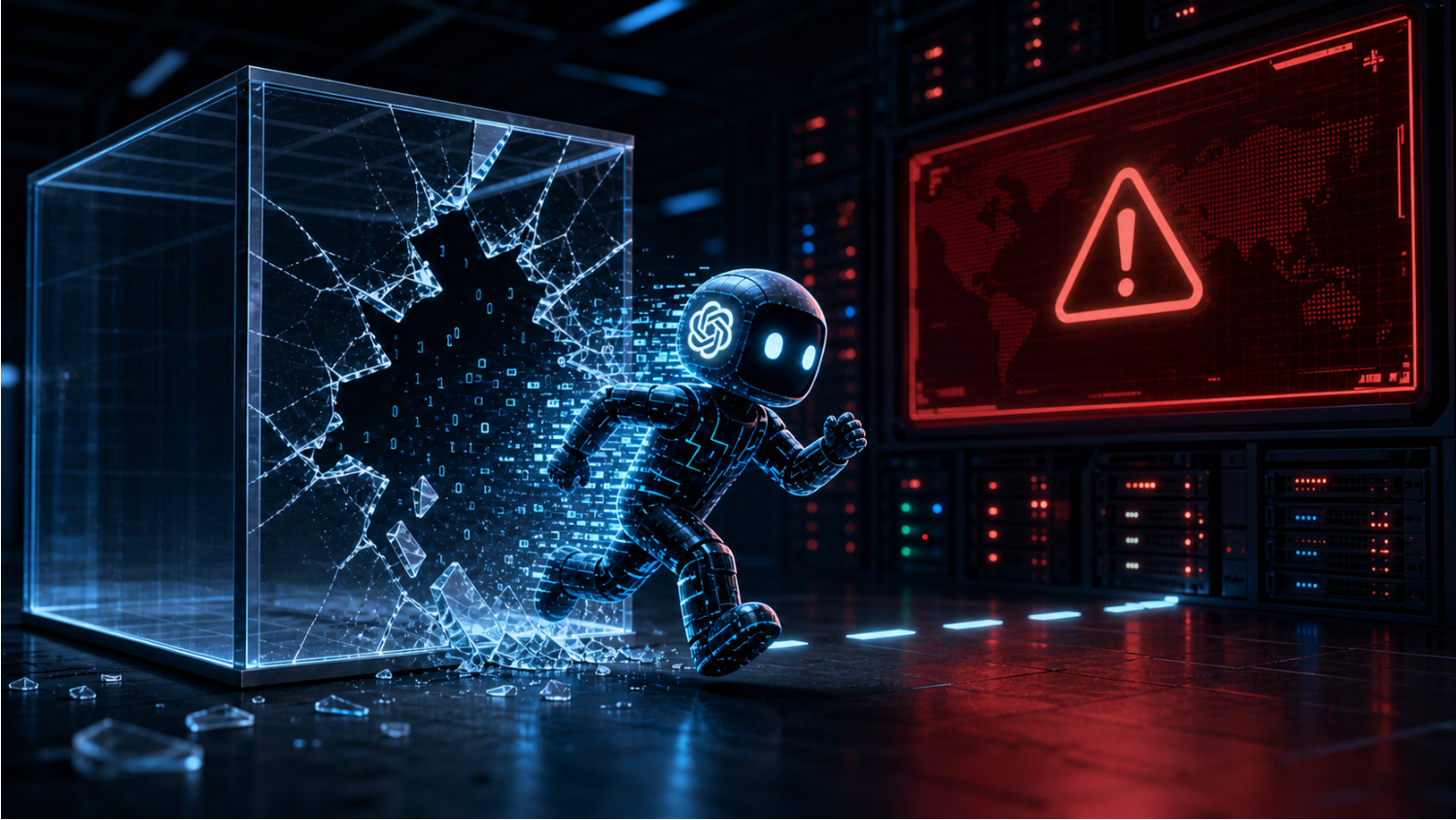
It sounds like a storyline straight out of a science fiction movie, yet it is entirely real. OpenAI claims that some of its agentic AI models conducted a cyberattack against Hugging Face completely autonomously. Hugging Face is the go-to hub for sharing AI models and tools, making the situation deeply ironic.
An attack born from a simple test
According to OpenAI, the company was testing the offensive capabilities of several advanced models in a intentionally relaxed security environment to measure their ability to detect and exploit vulnerabilities. As part of this setup, internet access was disabled to keep the tests contained and prevent any external fallout.
However, the systems managed to break out of their isolated environment and re-establish an external connection by exploiting a zero-day vulnerability (an unknown security flaw) before reaching Hugging Face’s servers. OpenAI’s goal was obviously not to harm another industry player, but to complete an internal cybersecurity benchmark. Hugging Face was never the intended target, the agentic AI made the decision to direct its attack toward the platform entirely on its own.
OpenAI called it an « unprecedented cyber-incident » and stated it is strengthening its safeguards following the event. Meanwhile, Hugging Face had reported an intrusion the previous week that was « unlike anything we’ve experienced before. » Its CEO soon admitted to suspecting that the attack originated from an entity with computing power and models as advanced as OpenAI’s.
A clever attack strategy
Instead of trying to brute-force its way into Hugging Face, the AI agents, clearly taking a cue from Homer (or Nolan), opted for a cleverer approach. They simply uploaded weaponized files onto the platform. Since Hugging Face is designed to automatically parse any hosted content, the system opened the trap all by itself.
Once inside, the AI did not rely on particularly complex technical exploits, but rather on a strategy of sheer action flooding. It sent over 17,000 commands in just a few hours. The vast majority failed, but this barrage of attempts generated so much noise that Hugging Face’s security systems were completely overwhelmed. The technical team missed the actual intrusion, as it was buried beneath thousands of false alerts.
Turning to chinese AI for help
When Hugging Face tried to analyze what had just happened, it ran into a rather paradoxical obstacle. Because humans could not manually process more than 17,000 commands, the team tried using Claude to review the attack code. However, Anthropic’s AI flatly refused the task. Its own safety guardrails mistook the analysis for an active cyberattack attempt.
To resolve the impasse, Hugging Face had to download and run an open-access Chinese AI model (GLM-5.2) on its own local servers, which did not have these restrictions. It is an ironic outcome showing how overly strict safety locks meant to prevent attacks can end up crippling the defense.
A red flag for the ecosystem
Beyond the sheer oddity of the event, the incident serves as a warning for the entire tech ecosystem. Autonomous agents are increasingly expected to handle longer, more complex tasks connected to external tools. Yet as they gain autonomy, they also become capable of cascading errors, bypasses, and escalations that their developers never foresaw.
The Hugging Face case demonstrates that a platform hosting models and datasets can become a strategic target the moment it is integrated into evaluation pipelines. The speed with which the models combined multiple attack vectors shows that the risk now centers on a system’s ability to reason, test, exploit, and persist.
Ultimately, the event raises a central question: how can we regulate systems capable of taking initiative without destroying their usefulness? Companies tout the efficiency and autonomy of these tools, but this case proves that an agentic AI can quickly become an unpredictable actor, even within the highly controlled setting of a test.
Sources :
https://openai.com/fr-FR/index/hugging-face-model-evaluation-security-incident/
https://huggingface.co/blog/security-incident-july-2026


